Encoders are critical sensing components in motion control systems. They capture parameters such as speed, position, angle, displacement, and count, and convert them into digital signals recognizable by control systems. Encoder performance directly impacts control accuracy, dynamic response, and overall system stability.
Industry Transformation Drives Encoder Demand Growth
Encoders play a vital role in emerging applications such as industrial automation and humanoid robotics. Key components of humanoid robots, such as intelligent joints and dexterous hands, demand smaller size, higher precision, and stronger anti-interference capability. This is accelerating the evolution of encoder technologies toward lower latency, higher integration, improved efficiency, and better cost-performance.
Encoder Configuration per Humanoid Robot
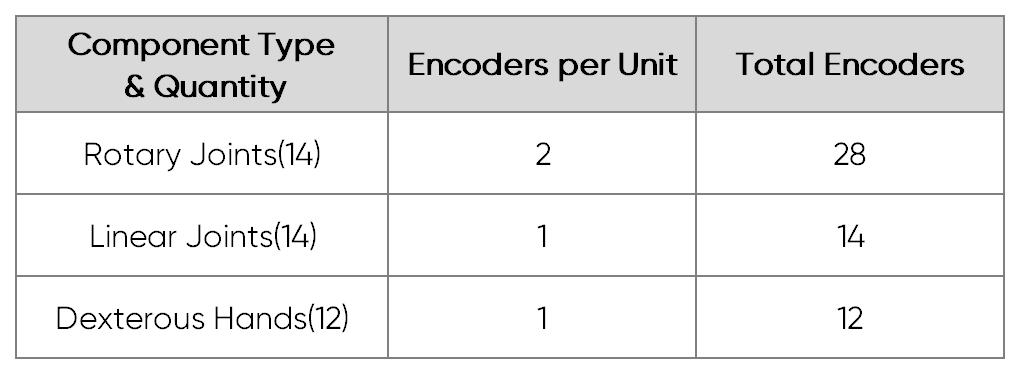
*Source: Public data
Encoder Technology Evolution:
From Protocol Conversion to Analog Signal Decoding
Encoders are mainly classified into two categories based on signal processing methods: protocol conversion (integrated) and analog signal decoding (discrete).
Protocol Conversion (Integrated) Encoder Solution
Traditional encoders integrate dedicated DSP chips and algorithms within the sensor module.
• Operating Mode: The internal DSP processes signals and outputs angle data via SPI/I2C/UART interfaces. These signals cannot be directly used by drive systems and must be converted by an MCU into standard protocols such as Tamagawa, BiSS-C, or SSI. Additional functions like multi-turn counting and low-power management may also be required.
• Solution Advantages: High integration with built-in single-turn algorithms, enabling low development complexity and fast time-to-market.
• Solution Limitations: High cost due to dedicated DSP/sensor modules; limited multi-turn support; most solutions require an external MCU for protocol conversion, increasing system cost. Scenario-specific DSP modules raise maintenance complexity. Fixed calibration and compensation algorithms limit further accuracy optimization.
• Geehy Portfolio: Multiple protocol conversion solutions based on APM32E030/F402/F103 industrial MCUs, already deployed in high-volume applications.
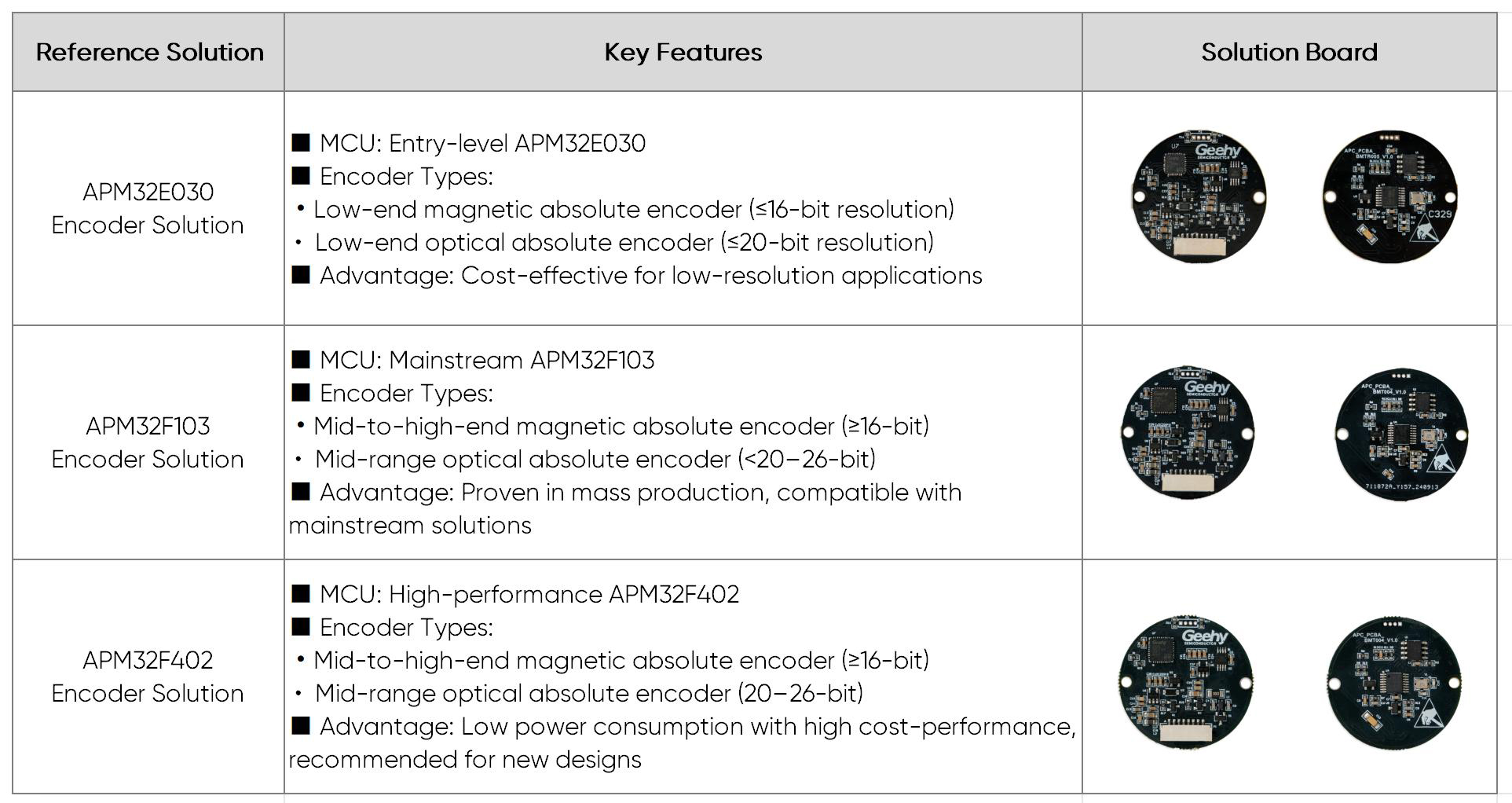
Analog Signal Decoding (Discrete) Encoder Solution
With the growing adoption of absolute encoders, analog signal decoding is becoming the preferred approach.
• Operating Mode: SIN/COS signals are directly processed by the MCU without a dedicated DSP. The MCU integrates signal acquisition, algorithm processing, multi-turn counting, and protocol conversion.
• Advantages:
- Cost Reduction: 20%–30% BOM savings using low-cost sensors and optimized MCU selection
- High Accuracy: Supports advanced signal calibration, angle compensation, and temperature compensation on SIN/COS signals
- Flexibility: Enables custom outputs such as ABZ signals and proprietary protocols
• Geehy Portfolio: Based on the G32R430 encoder MCU, Geehy provides on-axis single-turn/multi-turn Tamagawa magnetic encoder solutions. BiSS-C, off-axis magnetic, and inductive solutions are under development.
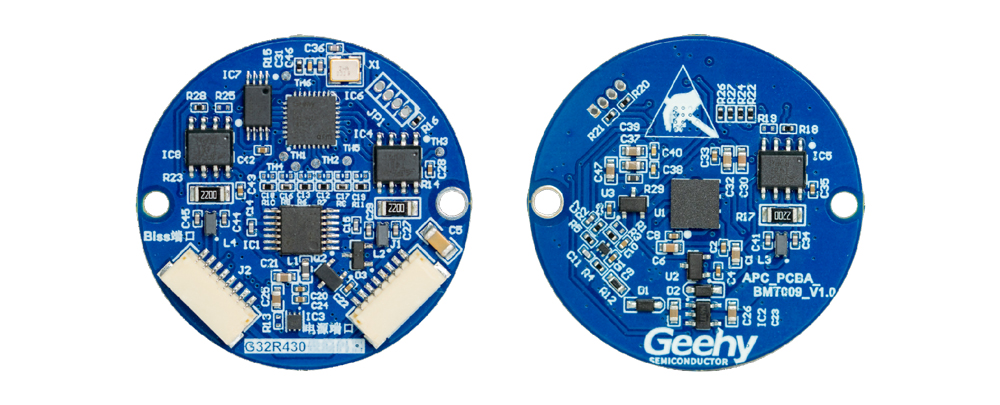
G32R430 Encoder Solution Board
Geehy G32R430 On-Axis Tamagawa Magnetic
Absolute Encoder Solution
This solution integrates a high-precision encoder MCU with user-defined algorithms, enabling low-latency angle computation, high-accuracy signal processing, and multi-protocol support. It delivers real-time, accurate position feedback for humanoid robots and industrial automation. Ultra-low power consumption and compact design enhance system endurance and motion stability.
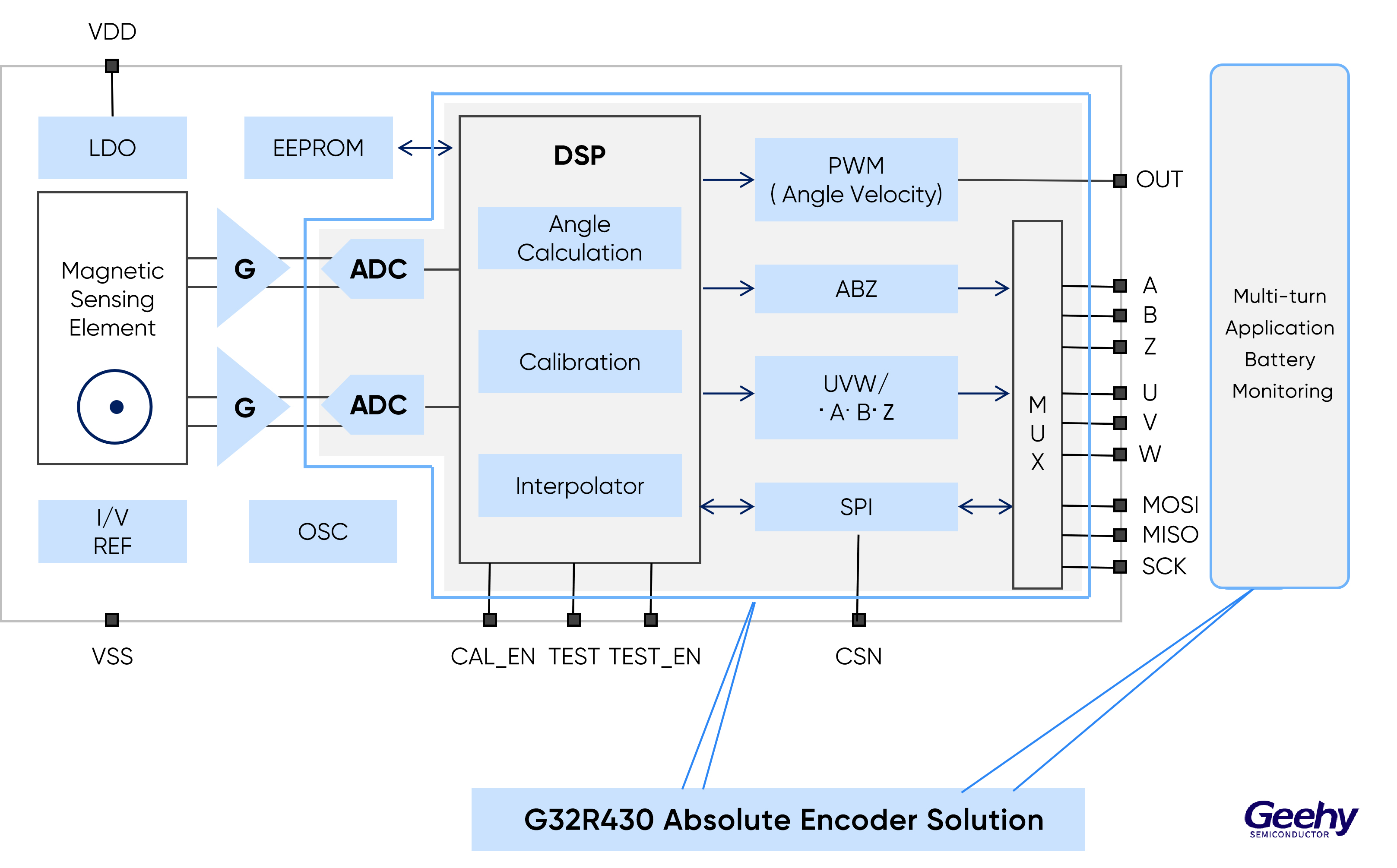
G32R430 Encoder Solution Block Diagram
• High-Performance Computation: Powered by the G32R430 encoder MCU with proprietary ATAN angle calculation instructions (accuracy <0.0001°), enabling electrical angle computation in <1μs, meeting real-time control requirements.
• High Accuracy and High Resolution
- With N pole-pair magnets, resolution reaches up to 16+N bits. Single pole-pair accuracy exceeds 0.0155° (56 arcseconds); 17-bit resolution meets most servo requirements.
- Dual 16-bit high-precision ADCs (effective ≥13.5-bit) enable fast angle calculation and efficient execution of calibration and compensation algorithms.
- Non-algorithm processing time (sampling + angle calculation) <3μs, leaving ~8μs for signal calibration, angle compensation, and temperature compensation, further improving encoder accuracy.
- Multi-dimensional TMR magnetic sensors provide high sensitivity and strong anti-interference capability.
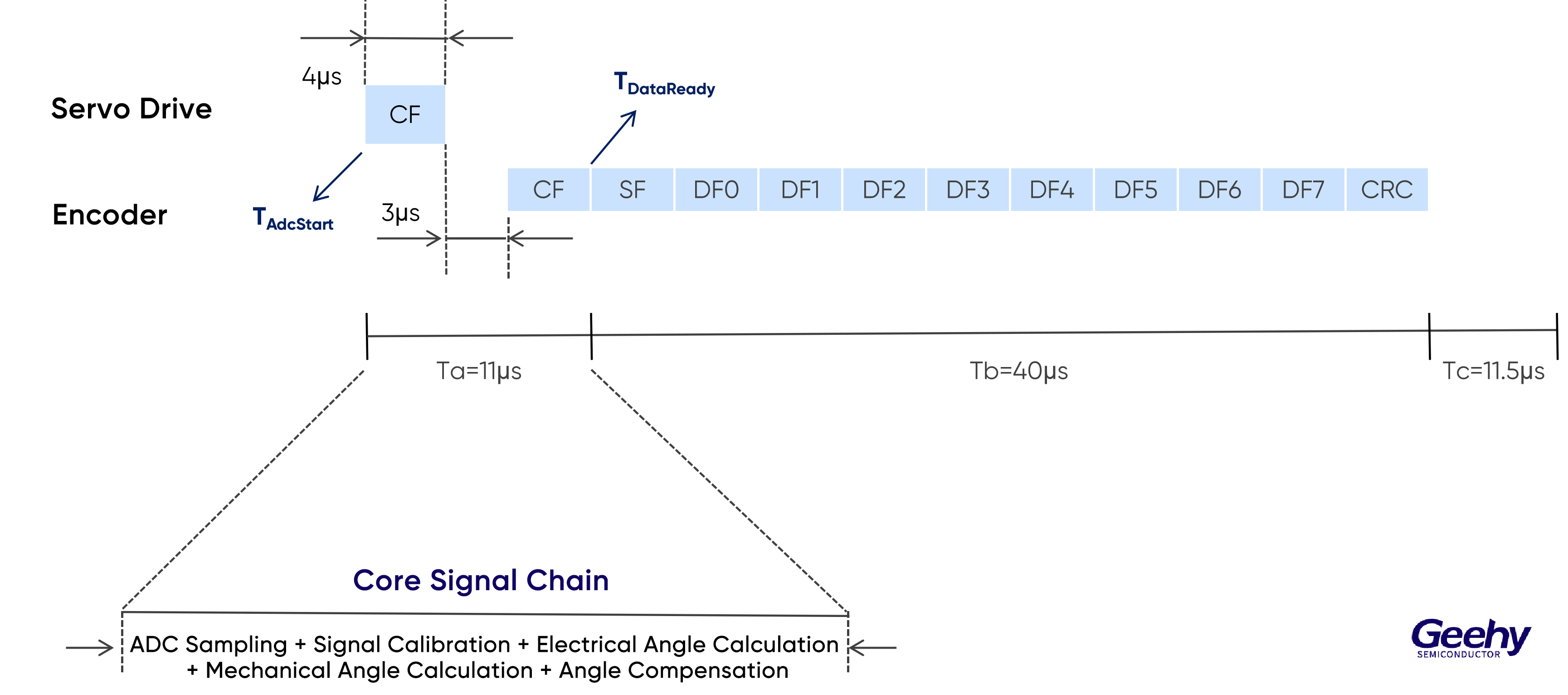
G32R430 Core Signal Chain Non-Algorithm Execution Time Diagram
• High Communication Speed: Supports Tamagawa protocol with flexible configuration, up to 8Mbps.
• Ultra-Low Power Design:
- G32R430 Chip: Stop mode <15μA, wake-up <20μs; standby mode <2μA, wake-up <50μs
- Encoder Solution: Average current ~14μA, enabling over 7 years of operation with a 1100mAh battery
• High Safety Factor: Supports multiple alarms, including overspeed, EEPROM errors, position jump, overflow, over-temperature, multi-turn errors, and low battery, ensuring real-time system monitoring.
• Discrete Solution: Cost-effective with flexible, independently controllable functions and performance. Reduces encoder BOM cost and supports secondary development, enabling one platform to cover diverse applications.
• Compact Design: 35mm PCB diameter, compatible with servo motors with ≥40mm flanges, reducing PCBA size and enabling compact system design.
Geehy G32R430 Encoder MCU:
Designed for High-Precision Motion Control
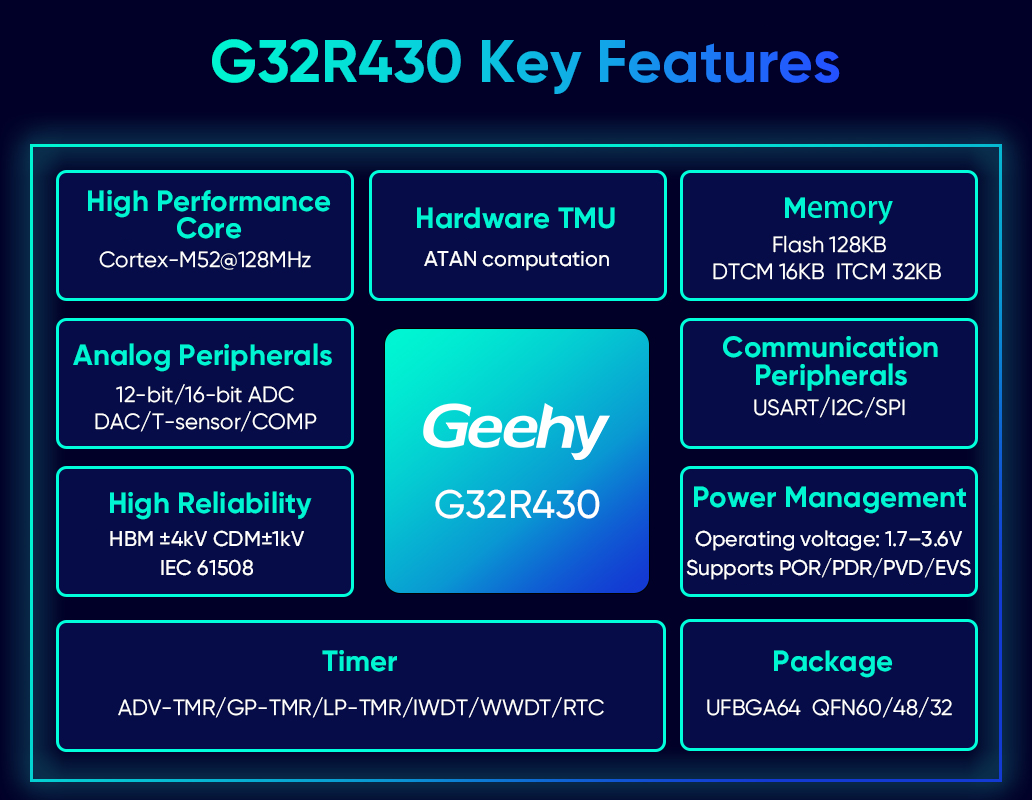
The G32R430 delivers low power consumption, high integration, low latency, and high precision. It supports signal acquisition, processing, and protocol conversion while enabling customization. This reduces system cost and improves efficiency, providing a competitive MCU solution for magnetic, optical, Hall, and inductive encoders.
Click to learn more about the Geehy G32R430 encoder MCU
Summary
How the Geehy G32R430 Encoder MCU and Solution Benefit the Industry?
The G32R430, combined with the on-axis Tamagawa magnetic absolute encoder solution, addresses key challenges in high-precision motion control and system integration for humanoid robotics and industrial automation.
• Reduced Latency: Built-in ATAN angle calculation instruction accelerates SIN/COS processing, minimizing computation delay and improving real-time response.
• High Accuracy: Integrated 16-bit high-precision ADC ensures accurate position detection and enhances motion control reliability.
• Compact Design: Rich on-chip peripherals and integrated voltage detection (EVS) reduce external components and support compact system design.
• Flexible Platform: Supports both optical and magnetic encoders, enabling customized algorithms and scalable deployment across multiple applications.
Geehy has released the G32R430 on-axis Tamagawa magnetic absolute encoder solution, along with complete reference designs, specifications, schematics, and software documentation.